
Our Blog:
Archive:
- 2020
- 2019
- 2018
- 2017
- 2016
- 2015
Tags
- dental implants (12)
- crowns (3)
- celebrity smiles (54)
- loose teeth (1)
- tooth grinding (1)
- wisdom teeth (5)
- gum disease (10)
- periodontal disease (2)
- cosmetic dentistry (7)
- orthodontic treatment (14)
- anchorage devices (1)
- oral hygiene (21)
- pediatric care (1)
- dental sealants (2)
- gummy smile (1)
- teeth grinding (3)
- athletic mouthguards (1)
- porcelain veneers (3)
- cracked mouth (1)
- oral health (20)
- bad breath (1)
- teeth whitening (4)
- orthodontics (5)
- braces (5)
- tooth replacement (1)
- clear aligners (1)
- abscessed tooth (1)
- pediatric dentistry (12)
- bonding (1)
- teeth wear (1)
- dental emergency (1)
- dental injury (4)
- root canal treatment (8)
- dental injuries (1)
- partial denture (1)
- retainers (4)
- dental cleaning (1)
- veneers (2)
- chipped teeth (1)
- tooth decay (3)
- laser dentistry (1)
- toothache (1)
- bone grafting (2)
- tooth pain (2)
- antibiotics (1)
- gum recession (4)
- topical fluoride (1)
- baby teeth (1)
- tooth extraction (1)
- tooth loss (1)
- sensitive teeth (1)
- tads (1)
- mouthguards (2)
- shingles (1)
- facial pain (1)
- trigeminal neuralgia (1)
- diabetes (1)
- dental records (1)
- dry mouth (1)
- bridgework (1)
- chipped tooth (3)
- tooth wear (1)
- smile makeover (2)
- nutrition (2)
- extraction (1)
- dentures (2)
- teething (1)
- dental implant (2)
- oral heath (1)
- vaping (1)
- retainer (1)
- root canal (1)
- loose tooth (1)
Categories:
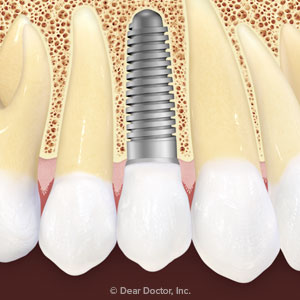
What's so special about dental implants — and why should you consider one to replace a missing tooth?
Although they've only been widely available for thirty years, dental implants have climbed to the top of tooth replacement choices as the premier restorative option. Since their debut in the 1980s, dentists have placed over 3 million implants.
There's one overriding reason for this popularity: in structure and form, dental implants are the closest replacement we have to a natural tooth. In fact, more than anything else an implant is a root replacement, the part of the tooth you don't see.
The artificial root is a titanium post surgically imbedded into the jaw bone. Later we can attach a porcelain crown to it that looks just like a visible tooth. This breakthrough design enables implants to handle the normal biting forces generated in the mouth for many years.
There's also an advantage in using titanium dental implants. Because bone cells have a special affinity to the metal, they will grow and attach to the implant over time. Not only does this strengthen the implant's hold within the jaw, the added growth also helps deter bone loss, a common problem with missing teeth.
It's this blend of strength and durability that gives implants the highest success rate for any tooth replacement option. Over 95% of implants placed attain the 10-year mark, and most will last for decades.
Dental implant treatment, however, may not be possible in every situation, particularly where significant bone loss has occurred. They're also relatively expensive, although more cost-effective than other options over the long term.
Even so, implants can play an effective and varied role in a dental restoration. While single implants with attached crowns are the most common type of replacement, they can also play a supporting role with other restorative options. As few as two strategically placed implants can provide a more secure connection for removable dentures or fixed bridges.
You'll need to first undergo a thorough dental examination to see if implants could work for you. From there, we'll be happy to discuss your options for using this "best of the best" restoration to achieve a new, beautiful smile.
If you would like more information on dental implants, please contact us or schedule an appointment for a consultation. You can also learn more about this topic by reading the Dear Doctor magazine article “Dental Implants 101.”